

What if building your freelance budget around your best months is the reason you scramble when work slows?
Build from the floor instead: the lowest monthly pay you can count on, not a wishful average.
This post shows practical steps to set a baseline budget tied to that minimum, sort essentials from flexible spending, and build a one-to-three month buffer.
Do this and you’ll stop panicking on slow months and start using busy months to breathe, not splurge.
Building a Stable Budget Framework with Irregular Income

Your baseline budget should tie to the lowest monthly income you can actually count on. Not what you hope to make. Not your best quarter average. The absolute floor.
When client work ebbs and flows, planning around best-case numbers sets you up to overspend during good months and panic when things slow down. Build from the minimum instead.
Next step is separating essential from flexible expenses. Essentials keep your life running: rent, utilities, minimum loan payments, insurance, and enough for food and transportation. Flexible stuff includes dining out, subscriptions, travel, new gear, entertainment. Income drops? Cut flexible first. Income rises? You can expand flexible spending, but only after your buffer’s funded.
A buffer fund covering one to three months of essential costs sits between you and a lean month. This isn’t your long-term emergency fund. It’s working capital that smooths gaps between invoices and bills. If your essential monthly costs run $2,400, keep at least $2,400 to $7,200 in a separate holding account. Draw from it during slow periods. Replenish during busy ones.
Setting up your baseline framework:
- Check your historical lowest month. Review the past 12 months of income and find the smallest deposit total in any single month.
- Add up your essential expenses. List every fixed cost (housing, insurance, debt payments) plus the minimum you need for groceries, gas, utilities.
- Set your minimum income target equal to or slightly above your essential expense total. That way you cover basics even in the slowest month.
- Put surplus toward your buffer fund. Whenever income exceeds the baseline, build that one to three month cushion before increasing discretionary spending.
- Adjust your monthly targets as your income floor shifts. Recalculate every quarter to reflect new client relationships or seasonal changes.
Analyzing and Averaging Your Freelance Income

Income averaging smooths out peaks and valleys so you spot real trends instead of reacting to single outlier months.
A three-month rolling average updates quickly and catches recent changes, but it swings wildly if one month is unusually high or low. A six-month average balances responsiveness with stability. A twelve-month average gives you the most conservative picture and works well for baseline budgeting because it includes a full cycle of seasonal ups and downs.
Most freelancers use the lowest figure from whichever period they choose as the foundation for their budget. If your six-month average is $4,200 but your lowest single month in that window was $2,800, the $2,800 becomes your baseline floor. Everything above that is surplus to put toward taxes, savings, or flexible spending.
| Period Length | Average Income Stability | Best Use Case |
|---|---|---|
| 3 months | Low (reacts quickly to recent changes) | New freelancers building initial data or tracking rapid growth |
| 6 months | Moderate (balances trend detection and smoothing) | Established freelancers with some seasonal variation |
| 12 months | High (includes full seasonal cycle) | Conservative baseline budgeting and long-term planning |
Structuring Expenses for Predictability
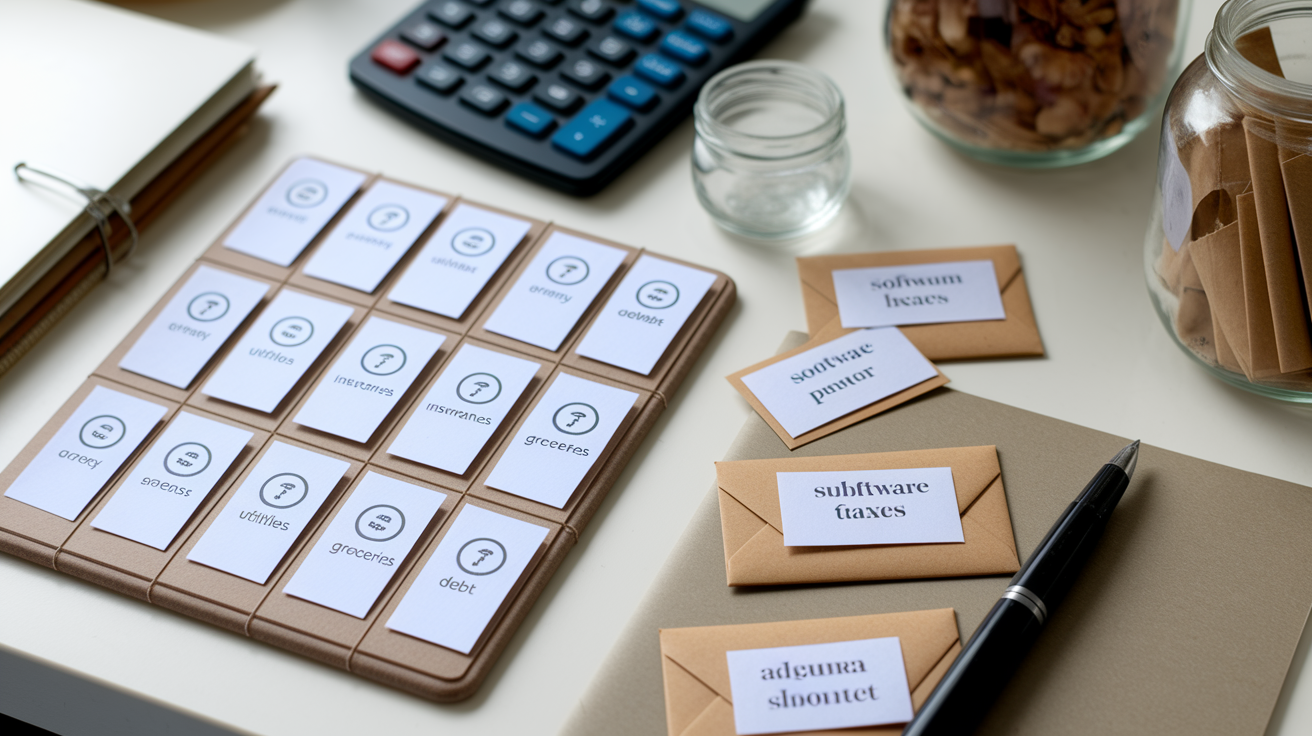
Essential costs don’t negotiate. Housing payments, health insurance, minimum debt obligations, utility base charges, basic groceries. These are the line items you fund first every month, regardless of how much work came in.
If your essential expenses total $3,100 and your lowest recent month brought in $3,200, you’ve got $100 of breathing room before dipping into reserves.
Variable costs like quarterly estimated taxes or annual software subscriptions need a different approach. Don’t wait for the bill to arrive and then scramble for cash. Create monthly sinking funds instead.
If your quarterly tax payment runs $1,800, set aside $600 every month into a separate tax savings account. When the due date arrives, the money’s already there. Same method works for annual insurance premiums, professional development, or equipment replacement.
Pre-planning annual expenses keeps surprises from turning into emergencies. List every cost you know will hit once or twice a year, divide the total by 12, and treat that monthly amount as a fixed obligation. If annual costs add up to $4,800, budget $400 per month and move it into a dedicated holding account. This transforms irregular expenses into predictable monthly transfers and prevents high-earning months from feeling deceptively flush.
Budgeting Methods That Work for Freelancers

Percentage-based budgeting assigns a fixed share of every dollar to specific categories, no matter how much you earn. A common split sets aside 25 to 30 percent for taxes, 20 percent for savings and buffer funds, 50 percent for essentials, and the remainder for flexible spending.
When a $5,000 month arrives, $1,500 goes to taxes, $1,000 to savings, $2,500 to essentials, and you’ve got discretionary room with what’s left. When income drops to $3,000, the percentages stay the same but the dollar amounts shrink automatically.
Zero-based budgeting requires you to assign every dollar a specific job before the month begins. You start with your expected or minimum income, put funds toward each category until you reach zero unassigned dollars, and adjust as actual deposits arrive. This method forces intentional decisions about every expense and prevents money from disappearing into vague spending. It works especially well when paired with a baseline income figure, because you never plan to spend money you don’t yet have.
An envelope or sinking fund hybrid combines the structure of zero-based budgeting with the flexibility of setting money aside for future bills. You create virtual or physical envelopes for taxes, insurance, emergency buffer, and irregular expenses, then fund those envelopes first each month. Whatever remains gets divided among groceries, utilities, and discretionary categories. If a lean month arrives, the envelopes stay untouched and you tighten discretionary spending instead.
Practical systems for variable income often include:
- Percentage allocation on deposit day. The moment income hits your account, automatic transfers move tax and savings percentages into separate accounts.
- Baseline spending limit. Your budget caps monthly outflows at your historical minimum income, treating everything above that as savings or debt paydown.
- Priority-based funding. Essentials and sinking funds get funded first. Discretionary categories only receive money after those obligations are met.
- Monthly reset with rollover. Unused discretionary dollars roll forward to the next month or move into the buffer fund, depending on your current reserve level.
Tools and Systems for Managing Variable Income

Spreadsheets give you full control and customization for tracking income streams, categorizing expenses, and running rolling averages. A simple Google Sheet or Excel file can separate tabs for monthly income, essential versus flexible costs, tax calculations, and buffer fund balances. Formulas automatically update averages and flag months when spending exceeds your baseline target.
Income tracking apps and budgeting software designed for irregular pay often include features like income smoothing, automatic category assignments, and visual dashboards that show cash flow over time. Some tools connect directly to bank accounts and auto-categorize transactions, while others require manual entry but provide stronger privacy and customization.
Useful tool types for freelance budgeting:
- Spreadsheet templates with built-in formulas for rolling averages, percentage allocations, and monthly comparisons.
- Zero-based budgeting apps that prioritize assigning jobs to existing dollars rather than forecasting future income.
- Accounting software that separates business income and expenses from personal spending and estimates quarterly tax obligations.
- Automated transfer systems that move fixed percentages into tax, savings, and buffer accounts on the same day income deposits.
- Time tracking and invoicing platforms that link billable hours to expected income and send automatic payment reminders to reduce late client payments.
Handling Lean Months and Income Dips

Buffer reserves exist for exactly this situation. When a slow month brings in $2,200 and your essential expenses run $2,800, you pull $600 from your holding account to cover the gap.
The key is treating the buffer as a short-term loan to yourself that gets repaid during the next high-earning period. Not as extra spending money.
Prioritizing essentials means you pay housing, insurance, minimum debt obligations, utilities, and basic food costs first. Discretionary categories like dining out, new subscriptions, travel, and non-urgent purchases get paused until income returns to baseline or higher. Small cuts in several flexible categories often add up to meaningful savings without requiring drastic lifestyle changes.
Adjusting your savings rate temporarily keeps you from draining reserves or missing critical bills. If you normally put 20 percent of income toward long-term savings and investments, dropping that to 5 or 10 percent during a two-month dip frees up cash for essentials without touching your emergency fund. Once income stabilizes, you return to the standard savings percentage and, if possible, make a small catch-up contribution to offset the temporary reduction.
Realistic Budgeting Examples for Freelancers

Seeing how other freelancers distribute funds across different income levels makes abstract percentages concrete. A low month might bring in $2,500, an average month $4,000, and a high month $6,000. The way you allocate those dollars shifts with your earnings, but the priority order stays the same. Essentials first, taxes and buffer next, discretionary last.
In a $2,500 month, you cover $2,200 in essential expenses, set aside $300 for taxes (roughly 12 percent, recognizing you’ll adjust later), and hold off on discretionary spending or new savings contributions. If your buffer fund already holds two months of essentials, you don’t add to it this month.
In a $4,000 month, essentials still cost $2,200, taxes take $1,000 (25 percent), you add $400 to your buffer fund, and $400 becomes available for flexible spending or additional debt paydown.
During a $6,000 month, the same $2,200 goes to essentials, $1,800 to taxes (30 percent), $1,000 to buffer and long-term savings, and $1,000 to discretionary categories or one-time expenses like equipment upgrades or professional development.
| Income Level | Essential Expenses | Savings/Buffer Allocation | Flexible Spending |
|---|---|---|---|
| $2,500 (lean month) | $2,200 | $300 (taxes only, no new buffer contributions) | $0 |
| $4,000 (average month) | $2,200 | $1,400 ($1,000 taxes + $400 buffer) | $400 |
| $6,000 (high month) | $2,200 | $2,800 ($1,800 taxes + $1,000 buffer/savings) | $1,000 |
Final Words
Start by setting a minimum monthly target based on your lowest month from the past 12 months. Separate essential costs from flexible spending, average income with a rolling period, and push extra pay into a 1-3 month buffer. Use percentage or zero-based methods and simple tools to automate transfers.
Practically, creating a baseline budget for variable freelance pay helps you cover essentials, ride out slow months, and make steady progress. It’s doable, and you’ll feel more steady soon.
FAQ
Q: What is the 3 3 3 budget rule?
A: The 3 3 3 budget rule is a simple plan for irregular income: use a 3-month rolling income average, keep a 3-month essential-expense buffer, and split pay into 3 core buckets (essentials, taxes, flexible).
Q: What is the 70-10-10-10 budget rule?
A: The 70-10-10-10 budget rule is a percent-based split: 70% for essentials, 10% to emergency or savings, 10% for taxes or debt, and 10% for flexible spending or investments.
Q: How to create a budget with variable income and how to budget for variable costs?
A: To create a budget with variable income and cover variable costs, use your lowest 12-month month as a baseline, list essentials, set a minimum income target, build a 1–3 month buffer, and use sinking funds for irregular bills.