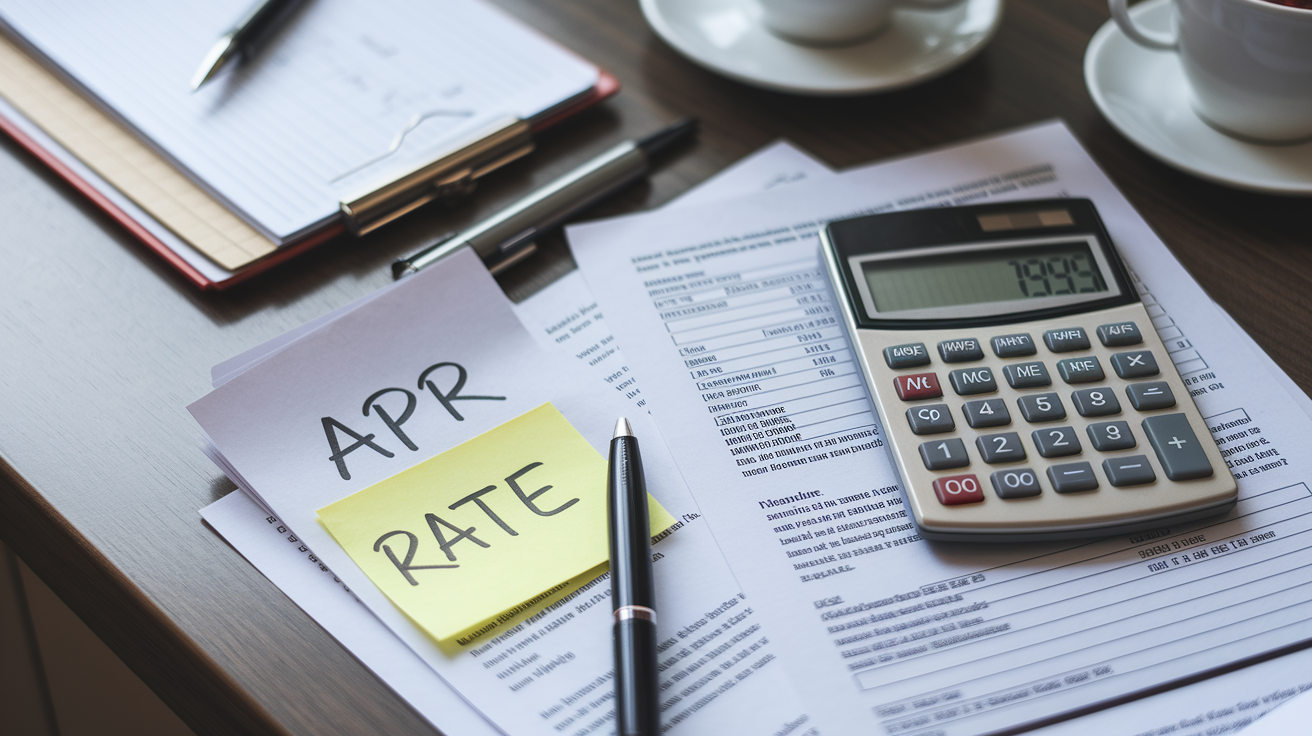

Think the interest rate tells the whole story?
A low rate can hide big fees that make a loan far more expensive.
APR bundles interest plus required fees into one yearly number so you can compare offers without a calculator.
Interest rate mostly controls your monthly payment.
APR shows total cost over time.
This post will walk you through when APR matters, how fees and loan term shift the math, and the simple questions to ask before you sign.
Core Breakdown of APR vs Interest Rate for Borrowers

The interest rate is how much a lender charges you to borrow money. Simple as that. It’s the percentage that controls how interest piles up month by month on the principal you borrowed. APR (annual percentage rate) takes that interest rate and adds in fees and other charges, then wraps everything into one annualized number.
APR shows you what a loan actually costs because it includes finance charges, origination fees, points, and required prepaid costs on top of the base interest. Lenders have to disclose APR thanks to the Truth in Lending Act, which means you can line up offers side by side without doing math on every lender’s different fee menu. Here’s an example: a 30 year mortgage at 3.50 percent interest with a 1 percent upfront fee on a 200,000 dollar loan (that’s 2,000 dollars) usually bumps the effective APR by around 0.05 to 0.25 percentage points once you spread that fee over 360 monthly payments.
Two lenders can quote the same interest rate but cost you totally different amounts because one loads up fees that inflate the APR. When you’re comparing offers, the interest rate mostly drives your monthly payment. APR tells you which loan costs less over the full term after accounting for the upfront and required charges.
Key Differences Between APR and Interest Rate
Fees included: Interest rate only reflects the cost of borrowing the principal. APR bundles in interest plus origination fees, points, closing costs, and other finance charges.
Comparison use: APR is the go to tool for comparing total loan costs when fee structures vary. Interest rate shows how interest accrues and determines the monthly payment size.
Impact on monthly payment: The interest rate directly controls your monthly payment and the amortization schedule. APR doesn’t change the monthly payment, but it shows the effective cost you’re paying over the full term.
When they diverge most: APR shoots higher than the interest rate when upfront fees are large, when the loan term is short (fees spread over fewer months), or when lenders pile on additional finance charges.
Regulatory disclosure: Lenders must disclose APR under TILA, giving borrowers a standardized cost comparison. Interest rate disclosure doesn’t require the same fee inclusive calculation.
Mechanics of How Interest Rates Are Determined

Interest rates can be fixed or variable. A fixed interest rate stays the same for the entire loan term, keeping monthly payments stable. A variable interest rate moves based on a benchmark index like the prime rate or SOFR, and your payment can go up or down when the rate adjusts. Some lenders offer teaser rates that start low for a short intro period, then jump to a higher rate later. Those rates pull borrowers in, but the initial savings can vanish if you keep the loan past the promotional window.
Several factors shape the rate a lender charges you. Market interest rates set a baseline cost of funds. Your credit score, payment history, and debt profile influence perceived risk. Lower risk usually earns a lower rate. The loan amount, term, and type also matter. Longer terms often carry slightly higher rates because risk extends over more time. Larger loans or secured collateral may reduce the rate. For example, a 20 percent interest rate on a 4,000 dollar, 2 year loan results in an approximate monthly payment of 204 dollars when interest is included, compared to 167 dollars if interest were ignored.
| Rate Type | Key Features | Example Scenario |
|---|---|---|
| Fixed | Stays constant for the entire loan term; protects you from rate increases. | 30 year mortgage at 4.00 percent locked through maturity. |
| Variable | Adjusts periodically based on a benchmark; monthly payment can rise or fall. | 5 year auto loan tied to prime rate, rate resets every 12 months. |
| Teaser/Promotional | Low introductory rate for a short period, then shifts to a higher ongoing rate. | Credit card 0 percent APR for 12 months, then reverts to 18.99 percent. |
How APR Is Shaped by Fees, Amortization, and Regulation

APR starts with the interest rate, then adds in all the required upfront and finance charges by spreading those costs over the loan’s term. The calculation uses an internal rate of return approach that treats the fees as if they were paid monthly instead of upfront, producing one annualized percentage. For a long loan, spreading a one time fee over many months generally has a smaller percentage impact. For a short loan, the same fee gets divided across fewer payments, so APR jumps higher relative to the interest rate.
Different fees influence APR differently depending on when they’re charged and whether they’re truly required to get the loan. An origination fee paid at closing increases the effective cost right away, so it adds to APR. Discount points you pay upfront reduce your interest rate but also cost you money at the start, so they raise APR even though the nominal rate goes down. Closing costs on a mortgage bundle together many services. Some charges (like title insurance or appraisal fees) count toward APR. Optional items or third party services may not. The combination of loan structure, fee type, and term length creates the variation you see when comparing APRs across lenders.
Regulatory standards require lenders to calculate and disclose APR consistently under the Truth in Lending Act. Every lender uses the same formula to include interest, points, origination fees, and other finance charges, giving you a uniform comparison number. The goal is stopping lenders from hiding the true cost behind low advertised interest rates while burying fees in the fine print.
Four Common Fee Types Included in APR
- Points (also called discount points or origination points) paid to reduce your interest rate.
- Origination fees charged by the lender to process and fund the loan.
- Closing costs that are required lender charges, such as underwriting fees or mandatory insurance.
- Prepaid finance charges like prepaid interest or certain insurance premiums required by the lender.
Practical Differences Between APR and Interest Rate in Loan Comparisons

Interest rate tells you how much interest you’ll owe each month and therefore determines the size of your payment. APR rolls together interest and fees to reveal the total effective cost you’ll pay when you hold the loan through its full term.
Consider a 10,000 dollar loan over 5 years at a 20 percent interest rate with no additional fees. Your monthly payment would be around 265 dollars, and by the end you’ll have paid roughly 5,900 dollars in total interest. Now suppose a lender offers the same principal and term at a 20 percent interest rate but includes origination and processing fees that push the APR to 28 percent. Your monthly payment climbs to about 311 dollars (46 dollars more each month) and your total cost to borrow (interest plus fees over 60 months) reaches roughly 8,700 dollars instead of 5,900 dollars. That difference of about 2,800 dollars is real money that APR helps you see before you sign.
| Scenario | Interest Rate | APR | Monthly Payment | Total Cost (Principal + Interest + Fees) |
|---|---|---|---|---|
| No upfront fees | 20% | 20% | $265 | $15,900 |
| With fees included | 20% | 28% | $311 | $18,700 |
| Difference | — | +8 pp | +$46 | +$2,800 |
APR differs most when lenders charge different fees for the same principal, term, and interest rate. Two offers with identical 6.00 percent interest rates can carry APRs of 6.15 percent and 6.75 percent if one lender charges a small origination fee and the other piles on discount points, application charges, and processing fees. By comparing APRs, you instantly identify which lender gives you the better deal without manually adding up every line on competing fee schedules.
How Fees, Points, and Loan Terms Change APR vs Interest Rate

Upfront fees are the most common reason APR rises above the interest rate. When you pay an origination fee or any required finance charge at the start, that cost gets divided over the loan term to calculate APR. The larger the fee, the bigger the gap between interest rate and APR. For example, a 1 percent origination fee on a 200,000 dollar loan is a 2,000 dollar charge. If the loan runs 30 years, that fee is amortized over 360 months and adds a small increment to APR, usually 0.05 to 0.25 percentage points. If the same 2,000 dollar fee is applied to a 3 year loan, the fee is spread over only 36 payments, which can push APR up by a full percentage point or more.
Discount points reduce your interest rate in exchange for paying money upfront. Each point typically costs 1 percent of the loan amount and reduces the rate by around 0.25 percentage points. Paying points lowers your monthly payment by cutting the interest rate, but the upfront cash outlay increases the effective borrowing cost captured by APR. If you plan to hold the loan long enough, the monthly savings can outweigh the upfront cost. If you refinance or pay off the loan early, you may not recover the points you paid, making the higher APR a true measure of the cost you experienced.
Fee and Term Factors That Increase APR
Points: Paying discount points upfront lowers the interest rate but increases APR because the cash is spent at the start.
Origination fees: Any percentage or flat dollar charge to process the loan adds to APR. Higher fees mean a larger APR increase.
Closing costs: Required lender fees (underwriting, processing, prepaid interest) count toward APR. Optional third party services often don’t.
Shorter loan terms: The same dollar fee divided over fewer months creates a larger percentage impact on APR compared to spreading that fee over a longer term.
APR vs Interest Rate Across Different Loan Types

Mortgages
Mortgage APR is heavily influenced by closing costs and points. A conventional 30 year fixed rate mortgage might advertise a 3.50 percent interest rate, but by the time you add lender fees, title insurance premiums, prepaid property taxes, and discount points, the APR could rise to 3.75 percent or higher. Closing costs on a mortgage are large in absolute dollars. Even when spread over 30 years they meaningfully increase APR. When comparing mortgage offers, request the Loan Estimate form. It lists the interest rate and APR side by side along with itemized closing costs, so you can see which lender gives you the lowest total cost over your intended holding period.
Credit Cards
Credit card APR includes the ongoing cost of revolving interest but doesn’t factor in one time fees the same way a mortgage or auto loan does. Promotional APR offers, such as 0 percent for 12 months, reset to a higher ongoing APR once the period ends, sometimes jumping to 18 or 24 percent or more. Credit card issuers calculate interest using a daily periodic rate, so the APR shown is the annualized version of that daily charge. Because balances can fluctuate monthly, APR on credit cards mainly helps you compare the cost of carrying a balance rather than a fixed loan cost.
Auto and Personal Loans
Auto loan APR can be inflated by dealer processing fees, documentation fees, and optional add ons like extended warranties or insurance products. Personal loan APR often includes origination fees charged as a percentage of the principal, typically 1 to 6 percent. Both loan types have relatively short terms (usually 3 to 7 years for autos and 2 to 5 years for personal loans), so upfront fees have a stronger impact on APR compared to a 30 year mortgage. When evaluating auto or personal loan offers, ask for a written breakdown of the interest rate, origination or dealer fees, and total finance charge so you can verify the APR calculation yourself.
Student Loans
Federal student loans often include an upfront loan fee deducted from the disbursement amount, which increases the effective APR. For example, federal direct unsubsidized and subsidized loans disbursed on or after October 1, 2020 carry a 1.057 percent fee. If you borrow 10,000 dollars, the fee is about 105 dollars, so you receive 9,895 dollars but owe interest on the full 10,000 dollars. Private student lenders may charge origination fees or application fees that similarly boost APR. Student loan APR also doesn’t reflect capitalization (unpaid interest that gets added to the principal during deferment or forbearance), so your total cost can exceed what APR suggests if interest compounds before you begin repayment.
Which Metric Matters Most by Loan Type
Mortgages: Compare APRs to assess total cost over your expected holding period. Use interest rate to understand monthly payment size and payment stability.
Credit cards: Focus on APR when you carry a balance month to month. Interest rate and APR are the same for ongoing charges, but watch for promotional rate resets.
Auto and personal loans: Prioritize APR for total cost comparison when fees differ across lenders. Verify the interest rate to confirm monthly payment affordability.
Student loans: Use APR to compare private lenders. For federal loans check the fee percentage and understand how capitalization affects total cost beyond the APR.
APR vs Interest Rate: Choosing the Right Metric for Borrowing Decisions

When you compare loan offers, APR is the most reliable number for judging which lender gives you the best deal on total cost. The interest rate tells you how much interest will accrue and what your monthly payment will be, but it hides fees and charges that increase the real price of borrowing. By requesting both the interest rate and APR from every lender, you can check monthly affordability with the interest rate and verify overall cost with APR.
You should also confirm whether the rate is fixed or variable, because APR calculations assume the interest rate stays constant over the loan term. If you have a variable rate loan, the disclosed APR reflects today’s rate and fees, but future rate adjustments can change your total cost in ways APR doesn’t capture. Itemize every fee the lender will charge (origination, points, application, underwriting, prepaid interest) and confirm those fees are included in the APR. Check the loan term carefully, because the same fee on a short loan inflates APR more than on a long loan. Run an amortization schedule or use a loan calculator to see monthly payments, total interest paid, and total cost including fees over the full term. Model an early payoff scenario to understand whether paying off the loan ahead of schedule saves enough interest to offset upfront fees.
Six Step Checklist for Comparing Loan Offers
- Obtain the APR and confirm it’s disclosed in the loan estimate or terms document required by regulation.
- Confirm whether the interest rate is fixed or variable and how often a variable rate can adjust.
- Request an itemized list of all fees (origination, points, closing costs, prepaid charges) and verify which ones are included in the APR.
- Check the loan term and total number of payments to understand how the loan is amortized.
- Run an amortization schedule showing principal, interest, and remaining balance each month to see total interest and total cost over the full term.
- Model an early payoff scenario to see how much interest you save by paying extra or refinancing, and compare that savings against upfront fees to determine whether a lower interest rate or lower APR saves you more money in your actual use case.
Common Misunderstandings and APR/Interest Rate Myths Debunked

Many borrowers assume APR and interest rate are interchangeable terms. They’re not. They measure different things. APR is nearly always higher than the interest rate unless the loan has zero fees. Advertised rates often highlight the interest rate in large print while burying fees in disclosures, so the rate you see in an ad may not reflect what you’ll actually pay. Lenders are required to disclose APR under the Truth in Lending Act, which means the APR number is regulated and comparable across lenders. Advertised interest rates aren’t held to the same inclusive standard.
Another common myth is that APR directly determines your monthly payment. Your monthly payment is calculated from the interest rate, loan amount, and term. APR shows the effective annualized cost including fees but doesn’t replace the interest rate in the payment formula. Some borrowers also believe APR captures all future costs, but it may not reflect prepayment penalties, late fees, optional insurance products, or the impact of variable rate changes after the loan is issued.
Four Myths and Corrections
Myth: APR always equals the interest rate: Correction: APR includes interest plus fees, so it’s usually higher. The two are equal only when there are no additional charges.
Myth: APR shows your monthly payment: Correction: Monthly payment is calculated from the interest rate and principal. APR measures total cost over the loan term, not the payment amount.
Myth: The advertised rate is the same as APR: Correction: Advertised rates often exclude fees. Always request the APR disclosure to see the true cost.
Myth: APR captures all future fees and penalties: Correction: APR typically includes upfront and required finance charges but may not reflect prepayment penalties, late fees, or future rate adjustments on variable loans.
Final Words
Know this: the interest rate is the percent you pay on the loan balance. APR shows the fuller yearly cost because it adds fees like points, origination, and some prepaid charges. Lenders must disclose APR, so use it to compare offers.
Watch the loan term, points, and whether the rate is fixed or variable. Short terms and big upfront fees make APR jump more than the interest rate.
Keep APR vs interest rate what borrowers should know in mind when you shop. Compare APRs, ask for itemized fees, and pick the loan that fits your budget.
FAQ
Q: Should you look at APR or interest rate?
A: You should look at both APR and the interest rate. APR compares total loan cost across offers, while the interest rate shows how your monthly payment will change.
Q: What is the 3 7 3 rule in mortgage?
A: The 3 7 3 rule in mortgage is not a universal standard. Some lenders use it as a quick underwriting shorthand with varying meanings. Ask your lender or broker for the exact criteria they apply.
Q: Can a 70 year old woman get a 30 year mortgage?
A: A 70-year-old woman can often get a 30-year mortgage. Approval depends on income, credit, and ability to repay. If income is limited, consider shorter terms, co-borrowers, or a reverse mortgage option.
Q: What is the best way to explain APR to borrowers?
A: The best way to explain APR to borrowers is to say APR shows the loan’s yearly cost, including interest plus lender fees. Use a simple numeric example and compare APRs to choose the lower total cost.